
Fraud and cover-up

Fraud and cover-up
On 17 July 2025, Elsevier fired me with immediate effect. I had led Energy Economics from a struggling second-tier field journal to the journal with the highest impact factor of all economics and finance journals, a journal that has a more diverse authorship than any other journal in economics, the journal that publishes more papers than most economics journals and brings in more revenue than all but one — all on a shoestring budget.
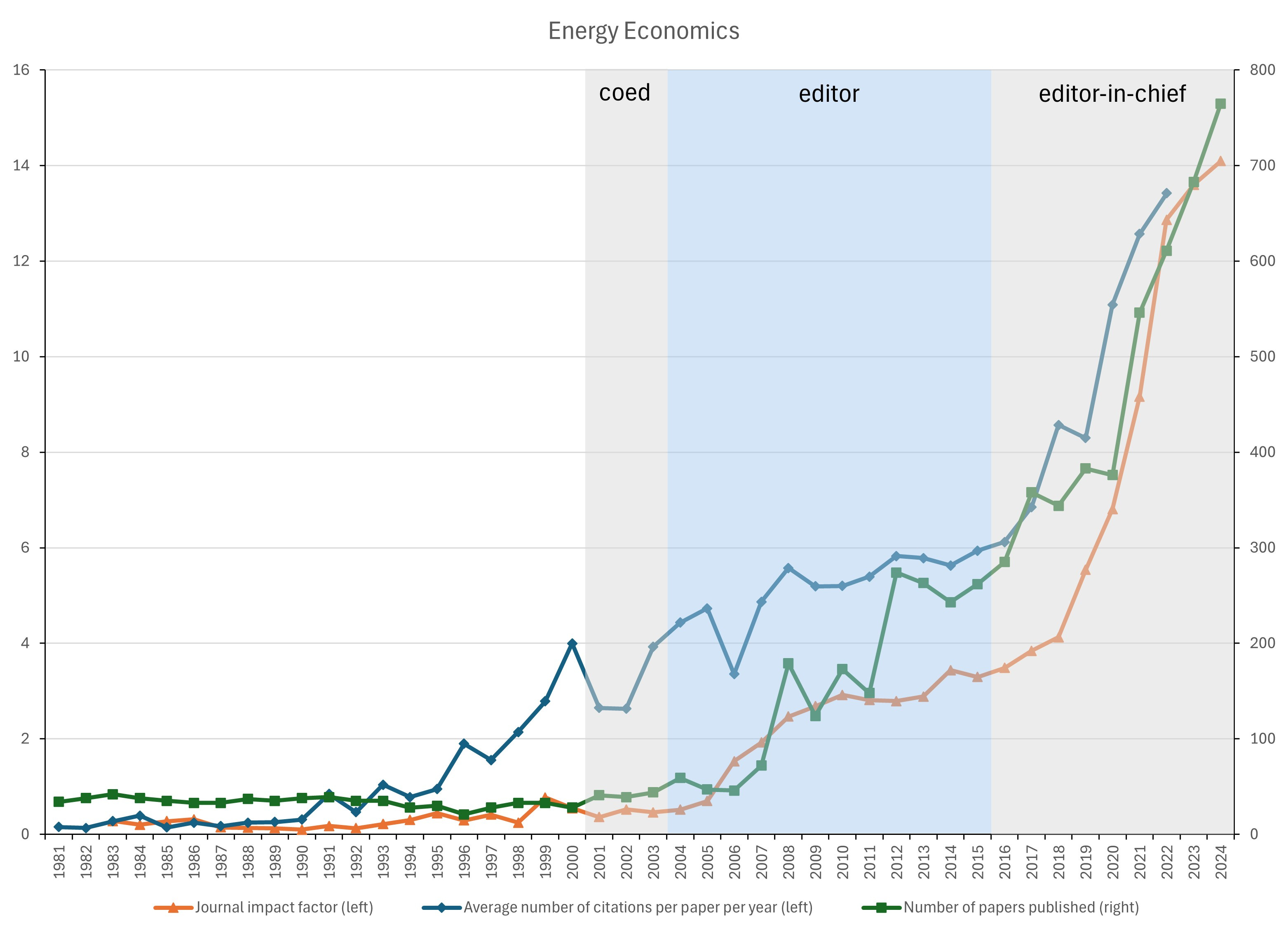
The decision was pointless. I had decided to step down before Christmas 2025 and had informed the publisher of my decision. This would have allowed me to conclude open investigations into fraud, see the papers in my care to the end, and gradually hand over to my successor.
My abrupt termination threw the journal into chaos. You would think that they had found kiddy porn on my computer.
But no. Elsevier gave two reasons for my dismissal. First, they do not like it when an academic, in charge of an academic journal, talks to other academics about an academic journal as an academic would. A senior official at Elsevier took umbrage when I told an author that he had faked data.
Second, Elsevier did not accept our collective decision to raise the quality standard for finance papers to the same level as for economics papers. This is an editorial decision.
I think the real reason is different. I recently had dinner with some editors of Elsevier’s finance journals. This was not a meeting of competing journals. It was a meeting of a group of friends who had cornered a market.
Some of the editors at the dinner table have been credibly accused of improper citation, manipulating peer review, soliciting financial and sexual favours, and accepting financial bribes.*
Elsevier have pressured Energy Economics to increase the volume of published papers. The publishing director said she values quantity over quality.
Under pressure, we increased the number of special issues — until we discovered that some of our guest editors could not be trusted. One case, with dubious reviews and allegations of money changing hands, was reported to Elsevier in August 2023. No action was taken on the credible evidence of bribery. The publisher ignored my retraction order for fake peer review.
There were other problems at Energy Economics. We had a budget to audit only a fraction of replication packages. Post-publication audits revealed many problems due to a mix of clumsiness and fraud. Some authors were manipulating citations, and some guest editors were too close to the authors in their charge. In the dozens of investigations of the last two years, some names kept popping up — many of them editors of other Elsevier journals and some at the dinner table above. I repeatedly reported this to the publisher, but with no discernible impact.**
It seems to me, therefore, that the real reason I was fired is that I got too close to exposing serious fraud at Elsevier.
There have been no retractions from Energy Economics over the summer — even retractions agreed to by the authors have yet to materialize. Too many retractions would have been a good reason to fire me. Indeed, publishing too many papers that should later be retracted is one of the reasons I decided to step down before my contract ended — but after I had cleaned up the mess. Elsevier seem to think it is better not to retract bad papers.
*Some have been accused of much worse.
**One editor was allegedly removed for an unrelated infraction: editing his own paper.
Sorry to hear all this, Richard. I'm a great admirer of your work and wish you well. The fact that Elsevier should behave like an abusive oligopolist is not particularly surprising. One can only hope that this insular, self-serving publishing model will die out, and Elsevier's lucrative business model will die with it.
"Our findings indicate that DF is highly instrumental in accelerating green growth in the studied nations, which can be conducive to attaining workhorse climate models that are sustenance and resilience and that facilitate environmental amelioration without decommissioning economic activities."
This is from the most cited work of 2024 in ex-your journal. I would call it word salad, because it is word salad. And this is exactly the value of your "impact factor," "diversity" and whatever other "achievements" of Energy Economics on your watch.
Well, the well-recognized frauds NA, RIL and AKT, who were on YOUR editorial board, are still there, and will drive the bibliometrics even higher up. More specialized predators demonstrate better survival, that's it.
Climate emergency is real. But so is green bullshit, which is what Energy Economics was and is about. Hard to have sympathy to all that, living in one of the most heavily affected regions of the planet.